The Truth About No-Monthly-Fee Medical Alerts
The search for a medical alert system with no monthly fee is one of the most common queries we see. The appeal is obvious — why pay $25 to $50 every month when you could pay once and be done? And there are devices on the market that promise exactly this.
But here is the reality that the one-time-purchase medical alert companies do not advertise prominently: when you eliminate the monthly fee, you also eliminate the 24/7 professional monitoring center that makes a medical alert system effective. The monthly fee is not a subscription for the device — it pays for the trained operators who answer the call, assess the emergency, dispatch the right help, and notify your family.
Let us walk through your options honestly so you can make the right decision.
How Unmonitored Medical Alerts Work
An unmonitored medical alert — sometimes called a personal emergency response device or an auto-dialer pendant — is a one-time purchase device that calls pre-programmed phone numbers when the button is pressed. You buy the device for $50 to $200, program in two to five emergency contacts (family members, neighbors, friends), and when the wearer presses the SOS button, the device calls those numbers in sequence until someone answers.
There is no monitoring center. No trained operator. No one assessing the situation or dispatching an ambulance. If the device reaches a family member, that person is responsible for figuring out what is happening and calling 911 if needed. If nobody answers — because they are at work, asleep, in a meeting, or their phone is on silent — the device keeps trying until it runs out of numbers to call.
The Risks of Going Unmonitored
The cost savings are real but so are the risks.
Nobody answers. This is the most dangerous scenario. If a senior falls at 2 AM and all five contacts have their phones on silent, the device has no fallback. A monitored system has operators standing by around the clock — someone always answers.
The contact does not know what to do. Even if a family member answers, they may be miles away and unable to assess the situation. A trained monitoring operator can ask the right questions, determine what type of emergency it is, and dispatch the correct response. A panicking daughter or son across town cannot do the same.
No GPS location. Most unmonitored devices do not include GPS. If the wearer pressed the button while away from home — at a store, on a walk, in a parking lot — the contact who answers has no way to find them. Monitored mobile devices transmit GPS coordinates to the monitoring center automatically.
No two-way voice. Many unmonitored devices only make a phone call. If the wearer cannot speak — due to stroke, severe pain, or disorientation — the contact who answers hears silence and may assume it was a pocket dial. Monitored systems use dedicated two-way speakers that are designed for emergency communication.
No fall detection. Automatic fall detection requires a connection to a monitoring center to process the alert. Unmonitored devices rely entirely on the wearer pressing the button, which defeats the purpose of fall detection.
Unmonitored Devices Worth Considering
If you have weighed the risks and still prefer a no-monthly-fee option — perhaps as a supplement to other safety measures rather than a primary emergency system — here are the types of devices available.
Auto-Dialer Pendants ($50-$150)
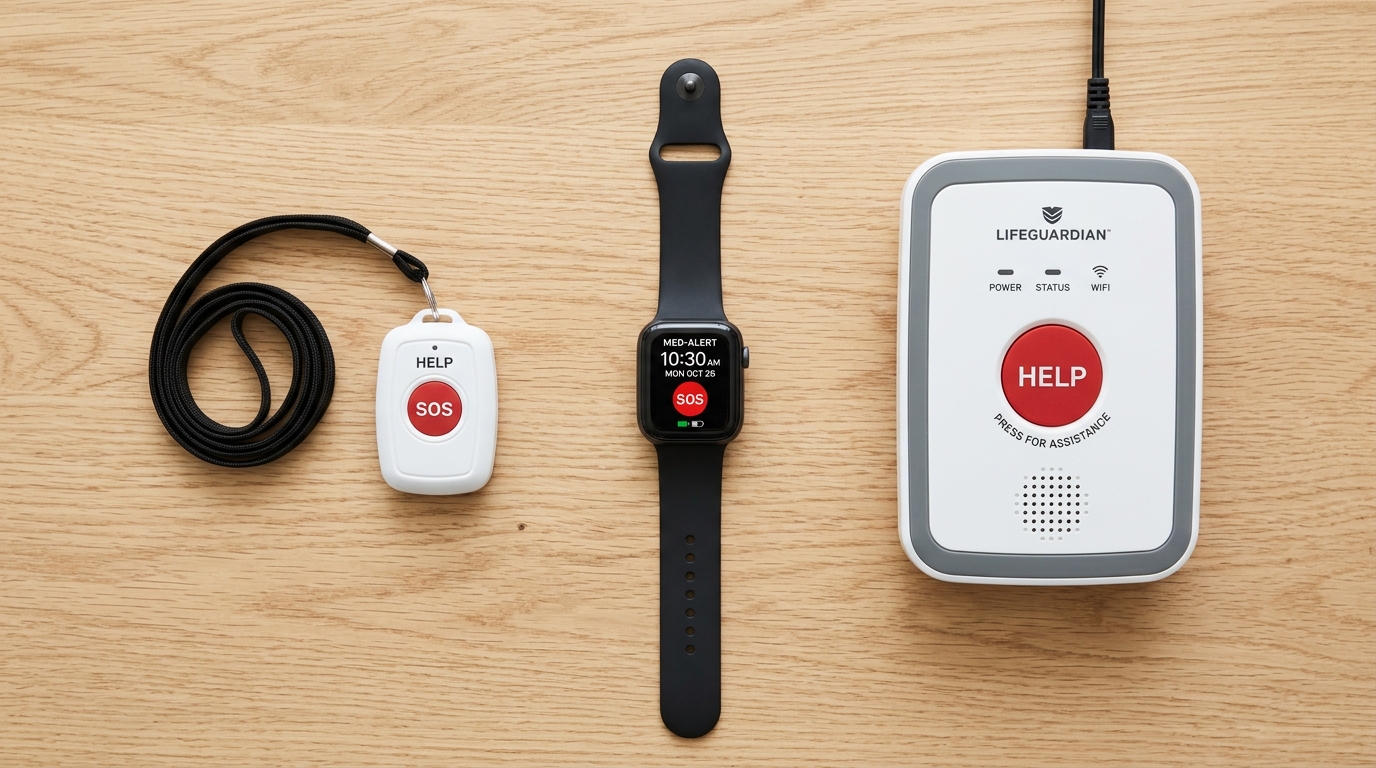
These are waterproof pendants with a single button that calls pre-set numbers when pressed. Some work over cellular networks, others connect to a landline. They are basic, reliable within their limitations, and widely available from brands found on major retail sites. Look for models with two-way voice and cellular connectivity for the most functionality.
Personal Safety Smartphone Apps (Free-$5/month)
Several smartphone apps offer SOS functionality where pressing an on-screen button sends your GPS location to designated contacts via text message and phone call. These work well for tech-comfortable seniors who always carry their phone. The limitation is obvious — the phone must be charged, unlocked or accessible, and in reach during an emergency.
Apple Watch and Samsung Watch Fall Detection (Device cost only)
Modern consumer smartwatches including Apple Watch and Samsung Galaxy Watch include built-in fall detection and emergency SOS calling. When a fall is detected, the watch can automatically call 911 and share the GPS location. This is the most capable no-monthly-fee option available, but it requires the wearer to be comfortable with smartwatch technology and to keep the watch charged and paired with a phone.
For seniors who already use an iPhone and would wear an Apple Watch, this is a reasonable option. For seniors who are not tech-savvy, it introduces more complexity than it solves.
Why Monitored Systems Are Worth the Monthly Fee
A monitored medical alert system costs between $20 and $50 per month. For that price, you get a trained operator who answers every call within 30 to 60 seconds — around the clock, every day of the year. That operator can assess the situation through two-way voice, dispatch an ambulance if needed, contact family members, and stay on the line until help arrives.
To put the cost in perspective, $27.95 per month (Bay Alarm Medical's SOS Home) works out to $0.93 per day. A single ambulance ride averages over $1,200. A hip fracture hospital stay averages over $30,000. A monitored medical alert system is among the most cost-effective safety investments a senior can make.

Our Recommended Affordable Monitored Systems
If the monthly fee is the primary concern, these monitored systems offer the lowest costs in the industry while maintaining professional quality.
MobileHelp Classic — $19.95/month
The most affordable professionally monitored system available. In-home coverage with a cellular base station and waterproof help button. No contract, 30-day money-back guarantee. This is less than $0.66 per day for 24/7 professional monitoring.
Bay Alarm Medical SOS Home — $27.95/month
Our top overall pick for value. Faster 31-second response time, cellular base station, waterproof pendant, and 32-hour backup battery. At $0.93 per day, it is a small price for the industry's fastest response.
LifeFone At-Home Landline — $24.95/month
The second-most affordable option, with the bonus of free spouse coverage. Two people protected for under $25 per month. Requires a landline connection.
The Bottom Line
We understand the appeal of no monthly fees. But for a device whose purpose is to save your life in an emergency, the reliability of professional monitoring is not something to compromise on.
Unmonitored devices are better than nothing, and they can work as a backup or supplement. But as a primary medical alert system, a monitored service from Bay Alarm Medical, MobileHelp, or LifeFone provides a level of safety and reliability that no one-time-purchase device can match.

If budget is the barrier, MobileHelp's Classic at $19.95 per month — less than the cost of a single takeout meal — provides full professional monitoring. That is the real no-compromise budget option.